Communication skills ABA therapy focuses on how each child asks for support, follows directions, expresses needs, labels items, responds to others, and uses language or alternative communication during daily routines. For children on the autism spectrum, communication challenges can affect speech, gestures, body language, facial expressions, social cues, and behavior.
Because communication needs vary widely from one child to another, ABA therapy starts with identifying each child’s current strengths and areas for growth. ABA therapy in Herndon starts with a comprehensive assessment so the team understands your child’s communication abilities, behavioral challenges, social skills, adaptive skills, and daily routines. From there, a Board Certified Behavior Analysts (BCBA) creates individualized therapy plans with goals that support your child’s communication needs.
Why Communication Skills Are a Focus in ABA Therapy
Communication skills are one of the primary focuses of applied behavior analysis because they affect how children participate at home, in school readiness activities, during social interaction, and in daily routines. When your child can’t yet ask for a break, request something they want, answer a question, or follow a direction, it’s easy for frustration to build up.
Some children may cry, walk away, refuse a task, or engage in challenging behaviors when they don’t yet have a reliable way to communicate what they need. Many behavioral approaches use observation and structured strategies to teach skills that support daily life. In applied behavior analysis (ABA), the team uses that same process to build communication skills, support effective communication, and reduce frustration.
A structured approach helps therapists identify which communication skills will have the greatest impact on your child’s daily life and build them step by step. Evidence-based ABA methods give therapists a better way to assess communication, teach one skill at a time, and track ongoing progress without asking your child to master everything at once.
What Communication Skills Can ABA Therapy in Herndon, VA Support?
Communication includes more than spoken language. Some children speak but still need support with social communication, understanding social cues, or using appropriate language in social settings. Others rely on nonverbal communication, communication boards, pictures, signs, or speech-generating devices.
ABA therapy in Herndon, VA supports:
- Requesting help, a break, or a preferred item
- Labeling objects, people, or actions
- Following one-step or multi-step directions
- Making choices during daily routines
- Responding to questions
- Using appropriate communication for the setting
- Understanding body language and facial expressions
- Practicing greetings, turn-taking, and simple conversation
The goal isn’t always starting with complex communication skills. Sometimes the focus is on teaching a reliable way to express a need without relying on behavior. Understanding what the individual’s starting point is helps the therapy team identify the most effective communication goals and build a plan that supports that progress.
How Do BCBAs Assess Communication Abilities?
Before teaching communication skills, Board Certified Behavior Analysts review how your child communicates now. The assessment includes spoken language, gestures, eye contact, facial expressions, nonverbal communication, social interaction, and what happens when communication breaks down.
The BCBA also looks at how your child requests items, labels familiar things, responds when asked to wait, follows directions, and uses body language. This helps the team understand your child’s communication abilities and decide which communication goals should be focused on first.
A comprehensive assessment keeps the therapy plan connected to your child’s development, daily routines, and specific needs. It also gives therapists a starting point for teaching communication skills that can be used in relevant settings.
How Does ABA Therapy in Herndon, VA Teach Communication Skills?
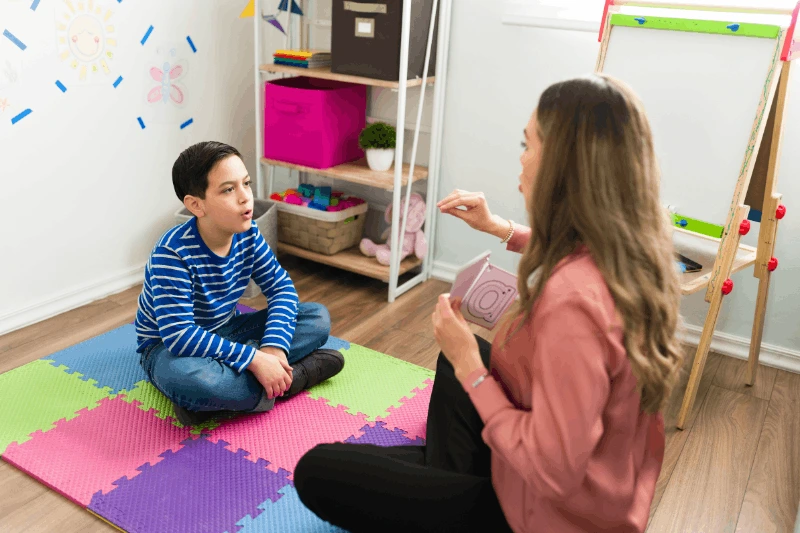
ABA therapy uses structure, practice, and positive reinforcement to teach communication in small steps. If the goal is requesting support, the therapist may begin with a prompt, then fade that prompt as your child becomes more independent. Prompting and fading help children develop communication skills without relying on the same level of support long-term.
Different ABA strategies can support different communication goals. Discrete Trial Training breaks skills into smaller tasks. Natural Environment Teaching brings communication practice into play, meals, transitions, and daily routines, which helps children use skills outside a structured environment. Verbal Behavior Therapy focuses on how language is used, including requesting, labeling, answering, and responding socially.
Functional Communication Training teaches your child a more reliable way to express a need. For example, instead of crying when a toy is out of reach, your child may learn to point, use a picture, say a word, sign, or use a device to request it.
Positive reinforcement supports skill development. When your child uses a new communication skill, the therapist reinforces that response so your child has a stronger reason to use it again.
For children who need additional support expressing themselves, therapists will also introduce alternative communication tools that match the child’s current abilities and communication goals.
When Are Alternative Communication Tools Used?
Some children need alternative communication while speech, language, or social communication skills continue to develop. Alternative communication gives individuals another way to express needs, make choices, and respond to others.
Augmentative and alternative communication (AAC) includes low-tech tools, such as pictures, sign language, or communication boards. It can also include high-tech tools, such as speech-generating devices. Speech-generating devices (SGDs) produce voice output, which gives children another way to communicate when spoken language is limited or still developing.
The Picture Exchange Communication System, or PECS, uses pictures to support functional communication. Sign language is another AAC option that uses hand movements rather than a device or picture system.
ABA therapists may coordinate with speech-language pathologists (SLPs), who are specialists trained to assess and treat speech, language, and communication challenges, when communication goals overlap. ABA therapy doesn’t replace speech therapy; it supports communication during daily routines while each professional works within their role.
As communication gets easier, it’s normal to become more comfortable connecting with other people, joining activities, and taking part in everyday interactions. These experiences also help social skills grow over time.
How Do Communication Goals Support Social Skills?
Communication challenges often become most noticeable during interactions with other people. Some individuals need support with greeting others, waiting, taking turns, responding to peers, noticing social cues, or understanding body language.
ABA therapy in Herndon, VA can break social communication into smaller steps based on your child’s current abilities and goals. For example, one child may begin by learning to respond when their name is called, while another may be ready to practice more advanced skills such as asking for help, joining play with peers, labeling items during activities, or using appropriate language during a group routine.
Building communication gradually allows each child to practice skills at a pace that matches their developmental needs while creating opportunities for social engagement.
Eye contact should never be forced, and children don’t need to communicate in the same way. ABA therapy focuses on developing communication skills that support your child’s independence, social interaction, and participation in daily life.
Because communication skills are most effective when they are used across different environments, support outside of therapy sessions plays an important role in long-term progress.
How Can Parents Support Communication Outside ABA Therapy in Herndon, VA
Communication skills grow most effectively when children have opportunities to practice throughout the day, not just during therapy sessions. Parents and family members play an important role by creating natural opportunities for communication during routines such as meals, playtime, getting dressed, leaving the house, asking for help, or getting ready for bed. Consistent practice across different settings helps children use communication skills more independently and confidently.
To make the practice effective, ABA therapy includes family training. Parents learn how communication goals are being taught during sessions and how to support those same skills at home. This includes learning when to use prompts, when to pause and give a child time to respond, how to reinforce communication attempts, and how to encourage communication during everyday activities.
Using the same strategies across environments helps children generalize communication skills beyond therapy sessions. For example, if a child learns to request a break during therapy, parents can create opportunities to practice that skill during homework, daily routines, community outings, or other situations where the skill is useful.
This consistency is especially valuable during early intervention. When communication challenges are identified early, therapists and families can work together to build foundational communication skills during important stages of development. The earlier those supports are in place, the more opportunities children have to practice communication in meaningful, everyday situations.
Starting ABA Therapy for Communication Support in Herndon, VA
Families looking for ABA therapy in Herndon, VA may be seeking support for communication, behavior, social skills, or daily routines. IABS serves families in Herndon and surrounding Northern Virginia communities through expert ABA therapy services guided by Board Certified Behavior Analysts and Registered Behavior Technicians.
The process begins with intake and assessment, then moves into plan development, 1:1 therapy, and family training. The therapy plan is based on your child’s communication abilities, behavioral needs, adaptive skills, family priorities, and daily routines.
Parents can review insurance support or the IABS FAQs before starting the process. If your child needs support with communication, social skills, behavior, or daily routines, families can learn more about available services and the assessment process. Speak with the IABS team about your child’s needs, learn how ABA therapy in Herndon, VA may help, and get answers to your questions during a personalized consultation.Request a consultation today to discuss autism therapy in Herndon, VA and explore the right support plan for your family.